Follow Grace_For_Life on Twitter

Sunday, June 26, 2016

Superior To Your Former Self?

Ernest Hemingway said this: “There is nothing noble in being superior to your fellow men. True nobility lies in being superior to your former self.”

Wait.

Before you get all, "Ooh, what a cool quote!", let me tell you this: You will never be "superior" to your former self enough to make you "noble".

Any nobility that man has is by virtue of the fact that we are created in the image of God.

Having been born sinful, the only ultimate way we will ever really be "superior" to our former self is if the Lord gives us a new heart as a gift of salvation, and we come to believe in the Lord Jesus Christ, and have our sins forgiven by Him.

Hemingway was one of the most successful authors in history. He traveled the world over, respected and lauded by the famous and powerful, and pretty much did whatever he wanted to do.

Coffee at sidewalk cafes in Paris, bullfights in Spain, hunting in Africa, fishing in Cuba.

But what he most wanted to do was to drink away the pain of an empty heart.

The very philosophy he expressed above was no doubt a large part of his undoing.

That's no doubt why Ernest Hemingway, at age 61, in beautiful Ketchum, Idaho, pointed his shotgun at himself and pulled the trigger.

His father before him had committed suicide also. So did his sister Ursula. And his brother Leicester.

You may be "superior" to your former self in writing, or art, or business, or sports, or speaking ability, or knowledge.

But to paraphrase Jesus, What does it profit a man if he gains the whole world of "superiority", but loses his soul? There is no nobility in that.

But the good news is that God came to Earth as a man, Jesus Christ. And He died on the cross for our sins, was buried, and rose again the third day.

And whoever believes in Him as Lord and Savior, shall not perish, but have everlasting life. With sins forgiven. Forever.

In that is true joy. And that's better than "nobility".

Friday, February 12, 2016

You Are Set Apart

There is a sense in which all believers in Jesus Christ are "set apart". It's the same as the words "made holy" or "sanctified". And it's true of all believers that they are "set apart" from the world and unto God when they become a Christian. That's what "Saint" means. (Contrary to the unbiblical teaching that a "saint" is some ultra-special miracle-producing high-end Christian who needs to be "canonized" to be a saint.) 

When we come to Christ, we are Saints. That's why Paul the Apostle addresses his letters to "the saints at..." whatever church he's writing to.

But did you know you are "set apart" even beyond that?

Listen to Paul in the Letter of Paul to the Galatians, Chapter 1, Verses 15,16:

"But when God, who had SET ME APART even from my mother's womb and called me through his grace, was pleased to reveal His Son in me so that I might preach Him among the Gentiles."

See, God had a plan for Paul. And He set Paul apart from his mother's womb!

No surprises for God. God is sovereign, and has planned (decreed) the end from the beginning. Paul didn't one day think, "I'm gonna be an apostle and a preacher", and God say, "Wow! I was hoping you'd do that!" No. He set Paul apart from his mother's womb.

Now listen here...

Do you think God is surprised at your life, Christian? Wouldn't that be ridiculous?

No, God has set you apart from YOUR mother's womb, too. I don't know for what. You might be a famous Bible teacher or preacher. Or you might be an unknown housewife or a businessman or a mommy or daddy or waitress or soldier.

But you are set apart for something. In fact you are set apart for LOTS of things, over the years. Your "something" may change from time to time. God has set you apart for that.

You may fail at things. Let me rephrase that -- you WILL fail at things. You may be confused at times on what you are set apart for.

Doesn't matter. You are set apart by God. From your mother's womb.

It could be one tiny word of caring that you utter, which helps someone else get through their day, so they can do what they were set apart for. It could be your sharing the gospel with your children, or a co-worker. It could be lifting up your spouse or family member or someone else, in prayer. If so, you were set apart for that. From your mother's womb.

Watch him work in your life in a thousand ways, and you will see (sometimes only looking back)  what you were set apart for.

And you know what? He will be glorified in that.

Monday, October 05, 2015

Is The Book of James Against Grace?


I have seen much confusion caused among believers because of a misunderstanding of the message of James in the Epistle of James. Some have glossed over it and made it seem as if James didn’t really say what he said, others have twisted the words of James to mean what they want it to mean, and others have outright rejected the Book of James, teaching or implying that it shouldn’t even be in the Bible.

In Martin Luther's preface to the New Testament, he wrote the famous words, "St. James' Epistle is really an epistle of straw, compared to them; for it has nothing of the nature of the Gospel about it." (Actually that appeared only in the 1522 edition. In the 1545 revision it was taken out.)

Is the Book of James against grace?

After all, James uses the word “law” 12 times, and “grace” only twice. He uses the word “works” 13 times, but the name “Jesus” only twice.

He even says blatantly, in James 2:24, "You see that a man is justified by works and not by faith alone." And he gives an example in James 2:25, "In the same way, was not Rahab the harlot also justified by works when she received the messengers and sent them out by another way?"

Is the Book of James against grace?

In case you’re getting a little nervous, the answer is, “No, James is not against grace." Two things are important here.

First, we need to understand that James is not just writing to believers.

He is writing to “the twelve tribes who are dispersed abroad”. These were Jews who were scattered around the then-known world, some of whom were now Christians.

You can never understand James until you realize that he was addressing unbelievers as well as believers, some who professed to believe in Jesus, and some who truly did believe. And James, in some of his comments, sort of throws them all into a hopper and mixes them up, and then tells them what’s what. You may not like his method here. You may prefer a systematic Paul, who more logically progresses with his points and makes it clearer whom he is talking to. But God has used James to make some points that no other Bible writer has made.

Second, we need to see the purposes in James' writing.

He was not laying down a theological treatise on salvation, or what we call soteriology. He wasn’t, like Paul in Romans, detailing the makeup of man, the work of Christ on the Cross, and the election, calling and justification of men by grace through faith.

To see these purposes of James, let’s do a very brief review of the Book of James, and comment on some of the issues James was dealing with. There are 5 chapters, and we’ll give each one a title, reflecting the main theme of each chapter. These 5 titles will begin with letters which spell out the word Works. W-o-r-k-s.

Chapter 1 “With Trials Comes Growth”

Chapter 2 “Only Works Show Faith”

Chapter 3 “Rudder-Tongue Steers Ship”

Chapter 4 “Keep Humble, Get Grace”

Chapter 5 “Suffer Patiently, But Pray”

So James is not against grace. But he wants true grace to be in evidence. Not a false or spurious grace. 

He wants to emphasize that when you become a New Creation, there will be fruit that comes from that. When you are born again, something happens. You are given a new spirit, which is the true you, the essence of your being, your very nature…a new nature which loves Jesus and hates sin. 

And when that new true nature of yours expresses itself, there will be good works. And when we walk by the Spirit, some of those works will be seen. 

And it’s all by Grace!

Saturday, May 02, 2015

Reflections On Cessationism (The view that certain spiritual gifts have ceased)


I’m saddened by the confusion brought into the Church by the so-called Charismatic Movement. This is not intended to be a comprehensive treatise on the subject, but just a vehicle for setting out some comments I made in a Facebook discussion, with the hope that they may be helpful to someone who has experienced that confusion.

I won’t include the comments of others in the following (you probably can intuit them), but here are a few comments I made:

NUMBER ONE

1. No one I know of says the gifts of the Spirit have ceased in general.

2. Many, however, including me, believe that the SIGN gifts have ceased.

Short reasons (as opposed to writing a book):

a. They were signs/wonders to authenticate the apostles in establishing the New Covenant — see Acts 14:3; 1 Cor 14:22; 2 Cor 12:12; Eph 2:20; Heb 2:3,4.

b. Comparing the true miraculous sign gifts of the Church of Acts with today’s nonsensical gibberish “tongues” and inaccurate “prophesy”, convinces me of the overt deception (including self-deception, sadly) of today’s supposed tongue-talkers and prophesiers.

c. What has been the result? A Trojan Horse brought into the Church to undermine the Scriptures, teaching that FURTHER revelation is needed, through these sign gifts. But all it has brought is confusion.

NUMBER TWO (In response to recommending D.A. Carson, a non-cessationist)

I’ve read Carson, Piper and Grudem [all non-cessationists whom I respect otherwise] on this subject and found them unsatisfying. Here’s why:

What they have proven exegetically, I believe, is that God COULD THEORETICALLY give someone the gift of tongues or prophecy today without violating the Bible.

But so what? The real question is this: IS HE DOING SO?

The answer, I believe, is as obvious as the pink elephant in the room — no.

And the problem with the nice-sounding argument that we must test today’s tongues and prophecies is that the Trojan Horse has swelled to an estimated 500,000,000 “charismatics” in the world today!

And by the time Diogenes and his lantern find an honest man (to use a comparison), and get through 400,000,000 of them, “testing” as he goes, and 400,000,000 of them are found to be phony, he still will swear that there might be a real one in the last 100,000,000!

And all 500,000,000 of them already swear that THEY are the real deal, shouting “shambala donna duego shabeeki”, or “Thus saith the Lord, ‘My people, and you are my people, seek me this day while I may be found, for dark days lie at your door, blah, blah, blah'” and call it tongues and prophecy.

Or to put it another way, I’m not a so-called cessationist because I think God could never theoretically give these sign gifts to anyone ever again — I’m a cessationist because it’s obvious to me that He is not doing so, and has not done so for many many years.

Sorta like He has “ceased” parting the Red Sea.

And though Carson and Grudem mean well, they are merely adding to the confusion.

NUMBER THREE (In response to the friendly accusation that I’m acting as if I’m omniscient on whether sign gifts have ceased)

I admit to a tiny bit of agnosticism on the subject, which is why I repeatedly use the term “theoretical”, but my agnosticism is on the level of theorizing that God might be parting the Red Sea, or at least the Jordan River, at this moment — though I’m pretty confident that tomorrow will show that He didn’t, just as I’m pretty confident that tomorrow will show that no biblical tongue talkers or prophets will cross my (or anyone else’s) path today.

I know these people.

I was heavily into it in the early ’80’s. I’ve met thousands personally, and witnessed tens of thousands second-hand. I’ve heard their “tongues” and heard their “prophecies” and witnessed their delusions as they laid hands on cerebral palsy patients and literally declared them healed while the victim of their delusion sat twisted in their wheel chairs — then brought guilt and shame on the victim because they didn’t have enough faith.

I’ve never met ONE who was not clearly self-deceived, or a blatant deceiver, or often both.

It’s tragic and confusing to the average person in the pew, who often feels superior because he is “Spirit-filled” (AKA tongue-talking) or feels a confused emptiness because he isn’t.

In the midst of the tragic stuff, there is occasionally humor. I’ll never forget the speaker at a Full Gospel Businessmen’s meeting in about 1982.

He declared from the podium, “I yoothed to have a thpeach impedimal, but God healed me.” Even the charismatic crowd had a hard time not chuckling. You could not tell that guy he still had a speech impediment.

And the Trojan Horse confusion marches on.

Saturday, January 24, 2015

Proper Christian Mysticism


It is possible (maybe even likely) that as a Christian reading this article, you fall into one of two camps regarding Christian Mysticism:

Camp 1. You think it’s perfectly acceptable to seek God for “a word”, or “a revelation”, apart from the truth that He has revealed to us in the Bible, the Word of God.

You think that “new truth” can be derived about God, or regarding God’s will for your life, by means of meditation, or even “lightning bolt” revelation apart from the Word of God.

You think nothing of carelessly saying, “God told me this or that” (though you might instinctively hedge your bet by asking, “What do YOU think?”, because in your heart you know He didn’t really “speak” to you.)

You point to folks in the second mystical camp below and say, “They’re just nothing but doctrine! Don’t you know God speaks to us?!”

Or…

Camp 2. You despise the very idea of being a Christian Mystic. You think Christian Mysticism is dangerous, and you take the Sergeant Joe Friday (“Dragnet”) view of truth and the Bible: “Just the facts, ma’am.”

You think that the revealed truth of Scripture is strictly an intellectual pursuit, and the more knowledge of that Scripture, the better — automatically.

You point to folks in the first mystical camp who look like fools in their mystical excesses, and say, “Forget mysticism, gimme Theology!”

I Believe Both Camps Above Are Wrong

Before specifying “why”, let me say these things:

1. Many folks would not consider themselves in either camp, but frankly are admittedly confused by the issue.

2. Theology is great. Since Theology is basically the truth of God and His ways, we NEED theology, and lots of it. In fact, we can’t know God without Theology, also known as Doctrine. If you hear a Christian demeaning Doctrine, they know not what they do.

3. Theology is not enough. First, because it has to be CORRECT theology, that is, biblical. Second, because correct theology has a purpose beyond even itself. “Just the facts, ma’am” is inadequate when it comes to Scripture.

Let me show what I mean directly from the Bible itself with three verses from 1 John.

=================================
“…that which we have seen and heard we declare to you, that you also may have fellowship with us; and truly our fellowship is with the Father and with His Son Jesus Christ.” – 1 John 1:3

“If we say that we have fellowship with Him, and walk in darkness, we lie and do not practice the truth.” – 1 John 1:6

“But if we walk in the light as He is in the light, we have fellowship with one another, and the blood of Jesus Christ His Son cleanses us from all sin.” – 1 John 1:7
==================================

Fellowship with Christ is Proper Christian Mysticism

Fellowship (from the Greek “koinonia”) with Christ is something which is alive and active, just like the Word of God itself. The Greek word is also translated “communion”, which gives some more flavor to this unseen spiritual reality.

As Christians, we can go well beyond knowing ABOUT Jesus Christ, to actually “communing” with Him.

But there are some principles for communing with Him, which we can derive from those passages in 1 John.

1. We need to walk in the light, not in darkness. That means we need the truth of the Scriptures! Without that truth, we simply cannot have real fellowship or communion with Him. This is where “Camp 1″ is in serious error. Serious.

Peaceful, mindless “feelings” can be had by practitioners of demonic Eastern religions, or by drugs, or even by spinning around in a circle until dizzy. Obviously that is not communing with Christ.

Fellowship with Christ includes fellowship with the very Apostles themselves (1 John 1:3). How is that possible? Through their ghosts, or disembodied spirits? Of course not. It is through their WRITINGS, inspired by God. Through the WORD of God.

2. Communion implies “communication”, and so it makes perfect sense that as we LISTEN to God through His Word, that we also SPEAK to Him in prayer.

In that sense, fellowship with Christ may be capsulized as “the Word of God and prayer”. When we say, the Word of God, we imply other things: reading, studying, memorizing, meditating on, and hearing teaching on the Word of God.

Of course, once we’ve “hidden” the Word in our hearts and minds, we have the beautiful BONUS blessing of being able to commune with Christ at will, even when we don’t have our Bibles in front of us.

But make no mistake, it’s not fellowship or communion if we merely “empty our minds”, or think our own thoughts and call it communion. Every thought must be taken “captive to Christ”. In other words, be HIS thoughts, through HIS Word. Then we may interact in prayer — a great privilege, by the way — as we “boldly come before His throne”, cleansed by the blood of Christ.

3. One more thing. Seek Jesus Christ in the Scriptures. It is about Him. All roads lead to Him. Gaze on Him as you take in the Word of God.

“But we all, with unveiled face, beholding as in a mirror the glory of the Lord, are being transformed into the same image from glory to glory, just as by the Spirit of the Lord.” – 2 Corinthians 3:18

This is proper Christian Mysticism.

Camp 1, get back to the Word, please. Don’t look for “revelation” outside of it. That will only keep you in confusion. The completed Bible God has given us is “sufficient” for every thing for which we need a word from God.

Camp 2, don’t fear communing with the Lord, as though it were some Eastern weirdness. He is in you. We are “one spirit with Him” (1 Corinthians 6:17). Our union with Christ is a mystical thing. It goes beyond doctrine, though it never violates it.

“The grace of the Lord Jesus Christ, and the love of God, and the communion of the Holy Spirit be with you all. Amen.” – 1 Corinthians 13:14


Sunday, November 02, 2014

Was "Saint" John Paul II A Great Spiritual Leader?


As many of you know, Pope John Paul II was “canonized” or officially declared a “Saint” by the Roman Catholic Church, on May 1, 2011.

Aside from the fact that Sainthood cannot biblically be given by the Roman Catholic Church, as I pointed out here, because all true believers in Jesus Christ are called saints in the Bible, it seems a good time to revisit the question whether John Paul (or any Pope, in this context) can legitimately be called a great spiritual leader at all — having just celebrated Reformation Day (October 31).

The following is not meant as a personal attack on Catholic folks, many of whom are my friends and family whom I love, nor as a personal attack on John Paul, or Popes in general. I find the current Pope Francis to be a likable guy, despite his appalling theology, which is constantly at odds with the Word of God, the Bible.

It’s about truth. As Jesus spoke to God the Father, “Thy Word is truth.” And that truth is found in the Bible, which is “inspired” by God, or literally, “God-breathed” — not in the words of mere men, “ex cathedra” or not.

I liked Pope John Paul II. He was kindly, charming, hard-working; a genius who spoke many languages, and he shared some of my own views on moral issues, such as the evil of killing our unborn, so I’m grateful for his influence in those areas.

And I wouldn’t judge his final destination, heaven or hell, because it’s God Who saves, by grace through faith, and none of us knows what may happen, even on a death bed.

But was John Paul a great spiritual leader? Particularly in this website about Grace, I must say “no”, for three reasons:

1) He taught and supported a religion of “grace” plus works. The Bible says clearly that if works is added to grace for salvation, it’s no longer grace (“But if it is by grace, it is no longer on the basis of works, otherwise grace is no longer grace.” –Romans 11:6)

Look at some excerpts from the Catechism of the Catholic Church (this is the “new” “modern” “open-minded” one…you should see the Traditional One!):

“. . Baptism is the first and chief sacrament of forgiveness of sins because it unites us with Christ, who died for our sins and rose for our justification, so that ‘we too might walk in newness of life,'”(Catechism of the Catholic Church, par. 977). [note this first of seven sacraments obtains the forgiveness of sins]

“In every circumstance, each one of us should hope, with the grace of God, to persevere ‘to the end’ and to obtain the joy of heaven, as God’s eternal reward for the good works accomplished with the grace of Christ,” (CCC, par. 1821). [note "as God's eternal reward for the good works"]

“Moved by the Holy Spirit and by charity, we can then merit for ourselves and for others the graces needed for our sanctification.” (CCC, par. 2010) [note we not only merit for ourselves, but for others]

And since the Catholic Church obviously teaches that salvation includes man’s works, then it follows that the failure of man’s works can destroy that salvation and damn him again, after he’s been “justified”. The solution: more works! Read the following:

“Christ instituted the sacrament of Penance for all sinful members of his Church: above all for those who, since Baptism, have fallen into grave sin, and have thus lost their baptismal grace and wounded ecclesial communion. It is to them that the sacrament of Penance offers a new possibility to convert and to recover the grace of justification. The Fathers of the Church present this sacrament as ‘the second plank (of salvation) after the shipwreck which is the loss of grace.” (CCC, par. 1446).

Acts of penance may be such things as prayer, saying the Rosary, reading the scripture, saying a number of “Our Father’s” or “Hail Mary’s”, doing good works, fasting, etc.

Hold on, I gotta breathe in some fresh air of the Word of God, here:

“You foolish Galatians, who has bewitched you, before whose eyes Jesus Christ was publicly portrayed as crucified? This is the only thing I want to find out from you: did you receive the Spirit by the works of the Law, or by hearing with faith? Are you so foolish? Having begun by the Spirit, are you now being perfected by the flesh? (Galatians 3:1-3)

2) John Paul also affirmed the Council of Trent, even traveling to Trento, Italy for the 450th Anniversary of the Council, and giving his approval. Among many other unbiblical teachings, the Council of Trent curses with damnation all of us who teach salvation “by grace through faith, not of works”. Excerpts can be viewed at http://www.carm.org/catholic/trent.htm .

3) Like many false teachers, John Paul was deceptive in his public speeches, opening the gates of heaven to almost anyone from Protestants to Buddhists, Hindus, etc., ignoring the words of Jesus, “I am the Way, the Truth, and the Life. No one comes to the Father except through Me.”

Whether by deliberate deception, or personal confusion, John Paul spoke out of both sides of his mouth when it came to whom are children of God. At best his sloppiness has caused masses (no pun intended) of people to miss the pure beautiful gospel of faith alone, by grace alone, in Jesus Christ alone. At worst, he deliberately said whatever itching ears wanted to hear, in order to win the crowds.

Either way, he could not qualify as a great spiritual leader.

Let me say, I have a particular love for Roman Catholics. I was once a member of the Roman Catholic Church myself, and my wife Michele was raised Roman Catholic. Many of our family members are of that faith.

If you are a Roman Catholic, or anyone who thinks that heaven can be earned by Sacraments or good works of any kind, I have terrific news for you:

Jesus died on the cross for our sins. He was buried and rose again from the grave, to give eternal life to all who will believe on Him and trust that His work on the cross was enough…who will believe that He meant it when He said on the cross, “It is finished.” Whoever will may come to Him. God calls all men everywhere to repent, to change their minds. No works can earn it. It’s a free gift of God. Believe on the Lord Jesus Christ and you shall be saved.

If you want to learn more about this Jesus Christ, I recommend starting with reading the Book of John in the Bible.

Tuesday, July 08, 2014

A Biblical Theology of Burial


I stumbled across a little article entitled “A Biblical Theology of Burial”. It deals with burial vs cremation, intending to do so in a biblical way.

Not to pick on the author, but I find it both fairly unbiblical, and not really theology.

It borders on silliness in some of its points and conclusions.

For example, he makes the statement, “Whatever one may say about burial verse [he means "versus"] cremation, this much we can be certain of, burial is a distinctively Christian practice.”

Burial is a distinctively Christian practice? Tell that to the hundreds of millions of Jews, Muslims, Hindus, and pagans that are buried. Except you can’t tell them — they’re buried!

Not to mention that several of his EXAMPLES of burial are Old Testament folks from before Christ!

The author also writes, “…a burial of the body of a believer is, in the truest sense, the last great act of faith that a believer may exhibit with his or her life.”

Except it’s NOT with his or her life — he or she is dead! And what’s written on a tombstone doesn’t save or damn the person who lived. Countless gravestones say things like “Safe In the Arms of Jesus”, when the dead guy didn’t know Jesus from a hole in the ground.

He concludes in part with, “While the Scriptures do not say that cremation is sinful in and of itself…”

And isn’t that the real point? There is NO scriptural teaching against cremation.

And if it’s supposedly an act of faith to be buried, as an indication that God will one day resurrect that ol’ body “mouldering in the grave”, could we not say that it’s even more an act of faith that God will gather all them lil’ ol’ specks of smoke and ash from a cremation, and resurrect a new glorious body?

So folks, if you wanna be buried, be buried. If you wanna be cremated, be cremated. If you even have a say in it.

Meanwhile, believe on the Lord Jesus Christ (He who, though God, came to Earth as a man, died on the cross for our sins, was buried and rose again the third day) and you will be saved — whether buried or cremated.

Here’s the article:

Saturday, July 05, 2014

Fuel Your Sense of Wonder -- Look At The Heavens

I love pondering the magnitude of the Universe. The gigantic size and beauty of Space.

I love standing out on my back patio at night, maybe with a wind blowing through our huge maple trees, and just looking up at the stars and the moon and contemplating the vastness of what God accomplished when He said, “Let there be”. And there was.

Psalm 19:1 says, “The heavens declare the glory of God, and the sky above proclaims his handiwork.”

When I was a new Christian back in the late ’70′s, I visited the Planetarium in my home town of Grand Rapids, Michigan. I’ve forgotten the regular Planetarium show that night, where you sit back in your seat, looking up at a huge white ceiling, and some astronomy lesson is projected out on the ceiling “sky”. I’m sure it was a good presentation.

But I still remember vividly, over thirty-five years later, the experience I had in the foyer of the Planetarium, as I was looking at some blown-up photographs of the sky, taken through high-power telescopes. Huge expanses of outer Space with too many stars to count printed on my brain, and I was struck with the awesomeness of the God Whom I’d just come to know.

Tears came as I realized that this awesome God, this Creator who cast not just millions of stars, but billions of galaxies out into Space by His Word alone, had created a little planet called Earth, and had come here in love, to give His only begotten Son, to save us from our sins if we would believe in Him.

If you are a believer in Jesus Christ, it’s important to not just take time to smell the roses, but take time to inhale the aroma of a God who by His Word made the star Antares.

Antares is a giant star, so much bigger than our sun that if it was placed where our sun is, 93 million miles away, the Earth would actually be inside of the star!

And Antares is just one of 500 billion stars in our galaxy called the Milky Way.

From America there is only one other galaxy that can be seen at all with the naked eye. That galaxy is called Andromeda, and is 2 million light-years away. That means that light, traveling at 186,000 miles per second, would take 2 million years to reach Earth.

And yet that’s a very very short distance in Space.

Until recently in human history, Andromeda was just thought to be another star. But with powerful telescopes, we came to know that Andromeda was actually a galaxy(!) twice the size of our Milky Way, and contains hundreds of billions of stars.

And the Milky Way and Andromeda are just 2 of 100 billion galaxies, each with billions of stars.

Which brings me to the second time I got tears in my eyes at the Lord’s creation of the heavens:

I think it was the early 90′s when National Geographic published some photos taken by the Hubble telescope. The Hubble is a very powerful telescope which was put into Space orbit, so that the earth’s atmosphere wouldn’t interfere with or distort what the telescope could see.

By the way, a side note. Did you know that if you took a globe — you know, a globe like you might have at home, that spins around and let us see the maps of the world in their actual shapes — if you took that globe and sprayed a coat of varnish on it, that coat of varnish would be the equivalent of about the actual thickness of the atmosphere on the earth, the air we breathe? Isn’t that amazing?

Anyway, back to the National Geographic photos from the Hubble telescope.

One of the sets of pictures showed a part of Space which we had previously only seen as a black empty spot of Space from our Earth telescopes. Then another picture showed that same black spot that we previously thought was empty, and Hubble had shown us that that black empty spot of Space actually contained whole new beautiful astounding galaxies of stars and worlds that we didn’t even have a clue existed.

I was stunned, and the immense power and majesty of the Lord who became our Friend, once again shook my heart with gratitude.

Philip Yancey tells the story of how he was visiting a refugee camp in Somalia, just below the equator. He writes,

“I had spent all day interviewing relief workers about the megadisaster of the moment. Kurdistan, Rwanda, Sudan, Ethiopia -– place names change, but the spectacle of suffering has a dreary sameness: mothers with shriveled, milkless breasts, babies crying and dying, fathers foraging for firewood in a treeless terrain.

“After three days of hearing tales of human misery, I could not lift my sights beyond that refugee camp situated in an obscure corner of an obscure country on the Horn of Africa. Until I saw the Milky Way. It abruptly reminded me that the present moment did not comprise all of life. History would go on. Tribes, governments, and whole civilizations may rise and fall, trailing disaster in their wake, but I dared not confine my field of vision to the scenes of suffering around me. I needed to look up, to the stars.”

The Lord asked Job, in the midst of complaining about his suffering, “Can you bind the beautiful Pleiades? Can you loose the cords of Orion? Can you bring forth the constellations in the seasons or lead out the Bear with its cubs? Do you know the laws of the heavens? Can you set up God’s dominion over the earth?”

Amazingly, Job was helped by these somewhat sarcastic questions from God.

Job had been focusing on earthly things, as horrible as they were. And the Lord lifted his eyes to the heavens. And Job was changed.

I’m changed too, when I contemplate the heavens.

The heavens declare the glory of God.

Don’t ever lose your sense of wonder at the God who created you. Step outside, day or night, and look up at the heavens. I don’t mean to be spooky about it, but just relax, just wait and let the heavens declare His glory.

It will fuel the sense of wonder that God wants you to have.

Here are some of the actual pictures from the Hubble, accompanied by Loreena McKennitt beautifully singing some words I can’t understand most of. :)


Sunday, June 22, 2014

Brief Analysis Of A Puritan Poem


I’ve picked on the Puritans before here and here.  But I thought it might be helpful to take a look at a Puritan poem and see how it applies to what I think was the Puritans’ defective view of the New Covenant.

Here’s the poem:

——————————————————–

O Lord of grace,
All Your lovingkindness is in Your Son,
I bring Him to You in the arms of faith,
I urge His saving name as the One who died for me.
I plead His blood to pay my debts of wrong.

Accept His worthiness for my unworthiness,
His sinlessness for my transgressions,
His purity for my uncleanness,
His sincerity for my guile,
His truth for my deceits,
His meekness for my pride,
His constancy for my backslidings,
His love for my enmity,
His fullness for my emptiness,
His faithfulness for my treachery,
His obedience for my lawlessness,
His glory for my shame,
His devotedness for my waywardness,
His holy life for my unchaste ways,
His righteousness for my dead works,
His death for my life.

—————————————————————

This is a perfect example of why I no longer recommend the Puritans except to the most discerning who already have a strong grasp on the radical nature of Grace and the New Covenant.

The Puritans were often confused on “it is finished” (tetelestai), and tended toward an odd form of legalism, wherein their “holiness” and “humility” were their “works” which mingled with grace (making it not grace at all, Rom. 11:6).

We’re not to “plead His blood to pay my debts” — it is paid already on the cross. Tetelestai.

We’re not called to beg the Father to “accept His worthiness” — He has already done so. Tetelestai.

So what’s important about these distinctions?

Simply that the Puritans did not understand the New Covenant, nor the obsolescence of the Old.

And the promotion of their pseudo-humility clouds and confuses the glorious New Covenant for those who already may have a hard time grasping the difference between the Old and New.

I say “pseudo-humility” because it’s really the “earning” of God’s favor by self-abasement disguised as humility.

It’s not humble to deny the “done” of the New Covenant by pleading for God to do what He has already declared that He’s done. It’s a twisted self-righteousness disguised as real righteousness.

The often-lauded “Valley of Vision” is full of this kind of stuff, which should frustrate the New Covenant grace-oriented believer, because it sounds so holy, but isn’t.

Humility is not “I’m nothing, I’m nothing”. It’s closer to “I am in Christ, a new creation, with all the wonderful things that entails — BUT, ‘what do you have O man, that you did not receive?’” — and so all glory goes to Him who did it — and who continues to sustain us and renew our minds until death, or until His return.

“Let no one keep defrauding you of your prize by delighting in self-abasement…” — Col. 2:18

“These are matters which have, to be sure, the appearance of wisdom in self-made religion and self-abasement…, but are of no value against fleshly indulgence.” — Col. 2:23

Tuesday, May 06, 2014

God's Acceptance of You -- And Love

What follows is a message for Christians.  If you are not a believer in Jesus Christ, I would urge you to come to Him.  He is God, the Son.  He came to Earth as a man, lived a sinless life, died on the cross for our sins, was buried and rose from the dead on the third day.

Whoever will believe in Him shall not perish, but have everlasting life. He said, “Whoever will come to me, I will in no way cast out.”

He also said, “Whoever will, may come.” Come to Jesus Christ today.  Believe in Him as Lord and Savior. Call on Him. “Believe on the Lord Jesus Christ and you shall be saved.”  Want to hear more about this great Lord and Savior?  Read the Gospel of John in the Bible. You might love it — and Him.

Now, for you who are a Christian, a believer in Jesus Christ:

If a believer in Jesus Christ has not “appropriated” the love and acceptance of God for them, that is, if they have not grasped in their very heart the utter unconditional way that God loves them and accepts them, then they will have a hard time really grasping the love and acceptance of other people for them.

Let me say that in another way.

If a person feels unloveable, or…

If a person feels that others can’t really love or accept them, or…

If a person feels that if someone really knew them, then that someone wouldn’t love or accept them, or…

If a person feels like if they only could do such-and-such or be such-and-such, or accomplish such-and-such, or be good enough, THEN someone might be able to love and accept them…

Then I believe that person has not understood their acceptance in Christ by God.

They may be born again, saved from their sins, and biblically knowledgeable, but they haven’t grasped the basic understanding of what their relationship is to the God Who loves them unconditionally.

They may even know about God’s acceptance of them intellectually, or logically. But they haven’t “appropriated” it spiritually, in the heart.

Sometimes they just need to be taught it from the Scriptures and they blossom as the light dawns in their hearts.

But other times it seems that a person must come to some crisis in their lives, some hopelessness in their own self-righteousness, some discouragement from imperfect people, some “whatever”, before the Lord opens their heart to the glorious truth that He doesn’t have a relationship with them based on performance.

But it must be spiritually discerned, and so it must be taught over and over and over. Faith even for that, comes by hearing and hearing by the Word of God.

Meanwhile, if you have that gnawing feeling that you just don’t measure up to the standard that would allow God to really love and accept you, if you are striving to please Him, and feel like you’re failing to do so, listen: He loves you. Yes, you.

Not just enough to die for your sins. Enough to dwell in you. Enough to “justify” you, to declare you righteous, just as if you’d never sinned. Enough to no longer have any condemnation for you. Enough to take you in His arms and comfort you with the truth that He fully, fully accepts you in the Beloved. Enough to call you His beloved — the apple of His eye.

And if you have that gnawing feeling that people can’t really love you — or they surely wouldn’t if they really knew you — understand that you feel that way because you have yet to really grasp God’s love and acceptance for you.

Those who have the Spirit of God surely can love and accept you, even if you have a hard time accepting it, because love is a fruit of the Spirit. And you will be sky-walking when you come to the knowledge of God’s love so strongly that you can say with all sincerity, “Even if no one else loved me, my Savior, my God, loves me, and that’s enough.”

And the irony is, that is when you may first be able to accept the love of other people like you never have before.

And then you can love like you never have before.

P.S. Critical: This is not Psychology, this is Theology. It falls under the heading “the Truth shall set you free.” The application is “If you really appropriate the Truth of the love and acceptance of God for you, then you will be set free to receive the love and acceptance of others (and to love and accept others).”

Saturday, April 19, 2014

Happy Easter!


Picture a mean bunch of guys, big rocks in their hands, hate on their faces, kicking up dust in the ancient Judean sun.

“For a good work we do not stone You, but for blasphemy, and because You, being a Man, make Yourself God!”

With these amazing words in John 10, the Jews gave their reason for trying once again to stone Jesus.

Not yet ready to die, and certainly not by stoning, Jesus escaped Judea and crossed the Jordan River to where John the Baptist had once baptized repentant Israelites, probably Perea.  He stayed there for a while, and many believed in Him there.

When word came to Jesus that his beloved friend Lazarus was deathly sick, He didn’t cross the Jordan back to Bethany near Jerusalem to visit his friend on his death bed.  No one could blame Him for staying .  After all, hadn’t the Jews repeatedly tried to seize and stone Him?  So the disciples didn’t blame Him, and they weren’t surprised that He stayed in Perea.  It only made sense.  Lazarus would have to rely on the comfort of His immediate family, Mary and Martha.

But the disciples were surprised a couple of days later, when Jesus said, “Let us go to Judea again.”  What?!

They said to Him, “Rabbi, lately the Jews sought to stone You, and are you going there again?”

And He told them He was going to raise Lazarus from the dead.  Do you think they believed Him?  I don’t.  I think Thomas spoke for all the disciples when he said, “Let us also go, that we may die with Him.”  They thought this was it.  The end.  Crazy, but hey, He’s the Lord.  We will follow Him and we will die with Him if necessary.

But they didn’t die that day.  They went to Bethany, and Jesus spoke the words that thrill our hearts, as believers in Him:

“I AM THE RESURRECTION AND THE LIFE.  HE WHO BELIEVES IN ME, THOUGH HE MAY DIE, HE SHALL LIVE.  AND WHOEVER LIVES AND BELIEVES IN ME SHALL NEVER DIE…”

And he raised Lazarus from the dead.

And later He died on the Cross.  They finally got Him.  They finally put an end to the One whom they said blasphemed because He said He was God.  And the brave disciples who went to Bethany with Him, willing to die, cowered behind a closed door, mourning the loss of their Rabbi, and their dreams.

We appreciate His death now.  We know that it paid for our sins.  We cringe at the horror of the Innocent One being beaten and scourged and crucified and separated from His Father as He took the fury of the Wrath of God on Himself.  We appreciate it.  But we don’t exactly celebrate it.

What we celebrate is that on the third day, He rose from the dead.  He authenticated that He is Who He said He was.  He is the Anointed One, God the Son, the Christ, the Messiah!  And He is alive!  And we say Hallelujah!  He is risen!

Even as a historical event, it’s noteworthy.  But He did it for a purpose.  He was “raised for our justification”.  He was crucified, buried, and raised from the dead, that we might live.  He said He came that we might have life and have it more abundantly.  And in some mysterious way, when He died on the Cross, we died with Him, and when He was raised, we were raised with Him, and seated with Him in the heavenlies, far above all rule and authority and power and dominion.

We were made alive spiritually, with the promise that we will be raised physically as well, on that Great Gettin’ Up Morning!  We became New Creations!  Old things have passed away, behold all things have become new!  There is therefore now no condemnation to those who are in Christ Jesus!  Hallelujah, what a Savior!

And all because He died for our sins.  He became sin for us that we might be made the righteousness of God in Christ!

He Is Risen!

Friday, April 18, 2014

It Is Finished


by Michele Rayburn

We have died once to the penalty of sin, and so we have peace with God. (“I have been crucified with Christ…”)

We are able to die daily to the power of sin because we stand in grace. (“… it is no longer I who live, but Christ lives in me…”)

And someday when we are present with the Lord, we will be free from the presence of sin. (“…and the life which I now live in the flesh I live by faith in the Son of God Who died for me and gave Himself for me.” – Galatians 2:20)

Jesus died once for our sins, and shed His blood for us, so that we can rest completely in His finished work on the cross.

Sometimes we as Christians live as if it isn’t “finished”. We live as if our sins are not forgiven, past, present and future. And we find ourselves trying to earn God’s favor each day.

But we stand in grace, in a permanent state of forgiveness, precisely because “It is finished.”


Sunday, April 13, 2014

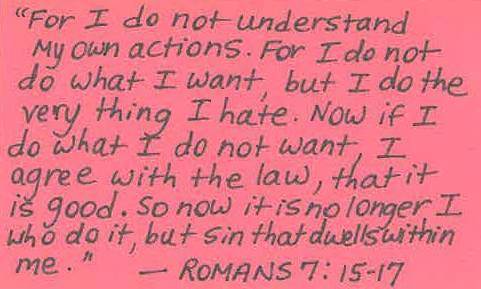
The Romans 7 Man


I’ve long thought that the “Romans 7 man” refers to a born-again Christian under the new covenant.

In fact, I believe that if one doesn’t grasp this Romans 7 dynamic of conflict which goes on in all of us believers, they will have one of two tendencies:

1. Pride, because they think they are following the law well enough to earn God’s love and favor, or

2. Despair, because they don’t understand what’s happening within themselves.

Anyway, here are some excellent persuasive reasons to understand that those Romans 7 passages refer to a new covenant believer:

http://feedingonchrist.com/john-pipers-10-reasons-romans-714-25-christians-experience/ 

The Object of Saving Faith

I’ve been fascinated for many years by the very simple-sounding Scripture which says, “Believe on the Lord Jesus Christ and you shall be saved.” — Acts 16:31

So simple.  So pristine. So devoid of works, sacraments, trappings of any kind.

“Believe on the Lord Jesus Christ and you shall be saved.”

(This presumes, of course, that it’s the true Jesus Christ — the One who is God who came to Earth as a man, and died on the cross for our sins, and rose again from the dead. If you don’t know who this Jesus Christ is, I recommend you read the Gospel of John from the Bible.)

What’s the point?

The point is that it is Jesus Christ himself, as Lord and Savior, that is the object of saving faith.

I like this little article that makes that point through explaining some things from John Bunyan’s Pilgrim’s Progress.


Monday, April 07, 2014

Where Do You Get Your Acceptance?

Honest folks will admit they have a desire for acceptance. Call it a “need” for acceptance if you want.
1. If you rely on acceptance by other people to meet that need, you will have roller coaster ups and downs, because people are imperfect.
Because they are imperfect, they will sometimes accept you only conditionally, and since you are also imperfect, that means sometimes they won’t accept you.
2. If you, like many, rely on acceptance from say, your dog, you will resent people for not being as accepting as your dog. When others say, “The more I’m around people, the more I appreciate my dog”, you will say, “Yes!”, and your resentment of people will sap your joy.
3. But if you rely on God for your acceptance, believing in Jesus Christ as your Lord and Savior, believing that He died on the cross for your sins, and resting in His forgiveness, you have the potential for your need of acceptance being met.
God accepts you completely in Jesus Christ. He never changes, He never waivers, He never accepts you “conditionally”, He will never not love you, He will never leave you nor forsake you.
Once you are His, as a believer in Jesus Christ, His acceptance of you is not based on your performance, so you are set free from earning your acceptance, like you might be prone to do with other people.
4. The more you understand and bask in His unconditional acceptance of you, the more you no longer rely on the acceptance of other people, and therefore are free to love them unconditionally, even when they’re not as nice as your dog.
5. The more you understand that His acceptance of you is not dependent on your performance, ironically you love Him more and desire to know and do His will. Who doesn’t want to serve one who so accepts us?
And double-irony, we end up thinking less about ourselves (and our acceptance) and think more about Him — like a child resting in the arms of an accepting parent, gazing into the face of of that loving parent, and loving them back.
Ephesians 1:6, “To the praise of the glory of his grace, wherein he hath made us accepted in the beloved.”

Wednesday, January 01, 2014

Behold He Makes All Things New

The First Sunrise of the New Year 2009


compiled by Michele Rayburn


Behold, He makes all things new...a New Covenant, a new creation in Christ, a new identity in Christ, a new spirit...


Psalm 40:3  He has put a *new* song in my mouth. Praise to our God; Many will see it and fear, And will trust in the Lord.


Psalm 96:1  Oh, sing to the Lord a *new* song! Sing to the Lord, all the earth.


Isaiah 42:9  Behold, the former things have come to pass, And *new* things I declare; Before they spring forth I tell you of them.


Isaiah 62:2  The Gentiles shall see your righteousness, And all kings your glory. You shall be called by a *new* name, Which the mouth of the Lord will name.


Isaiah 65:17  "For behold, I create *new* heavens and a *new* earth; And the former shall not be remembered or come to mind."


Jeremiah 31:31  "Behold the days are coming, says the Lord, when I will make a *new* covenant with the house of Israel and with the house of Judah."


Ezekiel 11:19  Then I will give them one heart, and I will put a *new* spirit within them, and take the stony heart out of their flesh, and give them a heart of flesh.


Ezekiel 18:31  Cast away from you all the transgressions which you have committed, and get yourselves a *new* heart and a *new* spirit. For why should you die, O house of Israel?


Ezekiel 36:26  I will give you a *new* heart and put a *new* spirit within you; I will take the heart of stone out of your flesh and give you a heart of flesh.


Matthew 26:28  For this is My blood of the *new* covenant, which is shed for many for the remission of sins.


Mark 14:24  And He said to them, "This is My blood of the *new* covenant, which is shed for many."


Luke 22:20  Likewise He also took the cup after supper, saying, "This cup is the *new* covenant in My blood, which is shed for you."


John 13:34  A *new* commandment that I give to you, that you love one another; as I have loved you, that you also love one another.


Romans 6:4  Therefore we were buried with Him through baptism into death, that just as Christ was raised from the dead by the glory of the Father, even so we also should walk in *newness* of life.


Romans 7:6  But now we have been delivered from the law, having died to what we were held by, so that we should serve in the *newness* of the Spirit and not in the oldness of the letter.


Romans 12:2  And do not be conformed to this world, but be transformed by the *renewing* of your mind...


2 Corinthians 3:6  God...who also made us sufficient as ministers of the *new* covenant, not of the letter but of the Spirit; for the letter kills, but the Spirit gives life.


2 Corinthians 4:16  Even though our outward man is perishing, yet the inward man is being *renewed* day by day.


2 Corinthians 5:17  Therefore, if anyone is in Christ, he is a *new* creation; old things have passed away; behold, all things have become *new*.


Galatians 6:15  For in Christ Jesus neither circumcision nor uncircumcision avails anything, but a *new* creation.


Ephesians 2:14-15  For He Himself is our peace...having abolished in His flesh the enmity, that is, the law of commandments contained in ordinances, so as to create in Himself one *new* man from the two, thus making peace...


Ephesians 4:22-24  ...put off, concerning your former conduct, the old man which grows corrupt according to deceitful lusts, and be *renewed* in the spirit of your mind, and that you put on the *new* man which was created according to God, in righteousness and true holiness.


Colossians 3:9-10  ...you have put off the old man with his deeds, and have put on the *new* man who is *renewed* in knowledge according to the image of Him who created him.


Titus 3:5  ...according to His mercy He saved us, through the washing of regeneration and *renewing* of the Holy Spirit.


Hebrews 8:8  "Behold, the days are coming, says the Lord, when I will make a *new* covenant with the house of Israel and with the house of Judah..." (Jer.31:31)


Hebrews 8:13  In that He says, "A *new* covenant," He has made the first obsolete.


Hebrews 9:15  He is the Mediator of the *new* covenant, by means of death, for the redemption of the transgressions under the first covenant, that those who are called may receive the promise of the eternal inheritance.


Hebrews 10:19-20  Therefore, brethren, having boldness to enter the Holiest by the blood of Jesus, by a *new* and living way which He consecrated for us, through the veil, that is His flesh...


Hebrews 12:22-24  But you have come...to Jesus the Mediator of the *new* covenant...


1 Peter 2:2  ...as *newborn* babes, desire the pure milk of the word, that you may grow thereby...


2 Peter 3:13  Nevertheless we, according to His promise, look for *new* heavens and a *new* earth in which righteousness dwells.


1 John 2:8  Again, a *new* commandment I write to you, which thing is true in Him and in you, because the darkness is passing away, and the true light is already shining.


2 John 1:5  And now I plead with you, lady, not as though I wrote a *new* commandment to you, but that which we have had from the beginning; that we love one another.


Revelation 2:17  And I will give him a white stone, and on the stone a *new* name written which no one knows except him who receives it.


Revelation 3:12  And I will write on him the name of My God and the name of the city of My God, the *New* Jerusalem, which comes down out of heaven from my God. And I will write on him My *new* name.


Revelation 14:3  And they sang as it were a *new* song before the throne...


Revelation 21:1  And I saw a *new* heaven and a *new* earth, for the first heaven and the first earth had passed away.


Revelation 21:2  Then I, John, saw the holy city, *New* Jerusalem, coming down out of heaven from God, prepared as a bride adorned for her husband.


Revelation 21:5  Then He who sat on the throne said, "Behold, I make all things *new*."


Morning Has Broken - sung by Cat Stevens

Tuesday, December 24, 2013

My First Real Christmas


After 26 years of living without acknowledging Jesus Christ in my life, in October of 1976, God opened my heart to Jesus Christ as Lord and Savior, and I became a Christian.
I tell that story in a recording made in 2007.

But at this Christmas time, I want to tell what that meant way back then as far as Christmas is concerned.
It was a stunning change, actually!
Christmas to me had always been a nice time to get together with family, decorate things, and give and receive gifts.  At times it also had a note of sadness and emptiness that I’m sure some of you may identify with, due usually to remembrances of days gone by with the questioning thought from the old song, “Is that all there is?”
But after being “born again”, becoming a Christian, Christmas was totally, totally, different.
All of a sudden, it MEANT something!  It was the birth of, not jut THE Savior, but MY Savior.  It was the time when God actually came to Earth as a man!  Emmanuel, God with us!
Everything was different.  I loved people like never before.  I saw the Christmas decorations and carols and gift exchange and hot chocolate and Christmas dinners and all the hoopla as REMEMBERING that Christ the Savior is born!
Even the “meaningless” stuff had new meaning for me, because it marked the birth of Emmanuel.
And it was the first time I understood that He wasn’t just born to be a “good example” or even a “good teacher”.
He was born to DIE on the cross for my sins, so that I could be forgiven and have eternal life with Him forever.
I couldn’t earn my own salvation with good works, it had to be a free gift.
And He offers that gift to ANYONE who will come to Him, who will believe in Him, who will trust that He died for our sins, and rose again from the dead.
And that Christmas, for the first time, I loved Him for who He is, and what He’d done for me.  And I still do, 37 years later.
That really was my first REAL Christmas, KNOWING the Son who was “given” by His Father.
I pray that you, dear reader will know Him too, if you don’t already.
“You shall call His name ‘Jesus’ for He shall save His people from their sins” – Matthew 1:21

Thursday, October 31, 2013

Celebrating Halloween With Abraham, Martin and John (Transcript)


In America Halloween is celebrated on October 31st. I don’t particularly like Halloween, especially its occult aspects, but that’s a message for another time.
I want to tell you a brief story of God’s grace.
Reformation Day
You see, October 31st is also Reformation Day, when we celebrate the light that dawned when the so-called Reformers began to break out of the darkness of Roman Catholicism, and once again began to preach salvation by grace through faith.
It was more than 490 years ago [1517 A.D.] that Martin Luther nailed his 95 Theses to the big wooden door of the Wittenburg Church, denouncing the sale of indulgences by the Roman Catholic Church, in which the souls of dead people were supposedly purchased out of the mythical Purgatory, or their time in Purgatory was shortened.
It was an evil practice, which preyed on the fears and superstition of the people, and made them poorer as the so-called Church grew richer.
Abraham
But I want to begin our story much farther back in time, to a man called Abraham.
Abraham was called by God out of Ur of the Chaldees, a pagan land with a pagan superstitious culture. God called Abraham away from his people and his culture, to begin a whole new people and culture, which eventually culminated in the nation Israel, and eventually the promised Messiah of Israel, the Lord Jesus Christ.
And the reason I want to begin with Abraham is because of a covenant that God made with Abraham. And this covenant became the forerunner to what we now call the New Covenant.
God promised Abraham that he would become a mighty nation, that he would have millions of descendants, through which the world would be blessed. Now the whole story is too long to tell here, but there was one little problem.
Abraham’s wife Sarah was barren, childless. And the years had passed, and Abraham had assumed that his heir would be someone from his household staff. This was customary when there was no offspring.
Let’s read the promise of God from Genesis Chapter 15, verse 4 and following:
“Then behold, the word of the Lord came to him, saying, ‘This man will not be your heir; but one who shall come forth from your own body, he shall be your heir.’ And He took him outside and said, ‘Now look toward the heavens, and count the stars, if you are able to count them.’ And He said to him, ‘So shall your descendants be.’”
Now Abraham could either believe that or not. Did he believe it?
Well, let’s fast-forward to the book of Romans and see what Paul wrote to the Romans about it, and at the same time we’ll learn a very important Bible truth about salvation.
In Romans 4:3,5 we read,
“For what does the Scripture say? And Abraham believed God, and it was reckoned to him as righteousness.” “…but to the one who does not work, but believes in Him who justifies the ungodly, his faith is reckoned as righteousness.”
Through the story of Abraham we learn something that has always been true:
Salvation is a free gift from God, through believing God. Or as the Bible says, by grace (that’s the free gift), through faith (that’s believing God).
And this salvation was paid for by Jesus Christ on the cross when he paid for our sins. The Bible says He became sin for us, so that we could become the righteousness of God.
In other words, He paid the price, so that we could be declared or reckoned righteous by God, Who gave us the gift of His own righteousness, when we believed in Jesus Christ.
There is no other way, and there never has been.
Even the blood of bulls and goats could not take away sin, the Bible says in Hebrews 10:4. All the blood of the sacrifices of Israel did were to temporarily cover the sins of the people until the time that the Messiah could shed His blood to pay for and take away sins.
But salvation was always by grace (a free gift) through believing God.
Now let’s fast-forward a few hundred years beyond Paul and the other Apostles, who taught this beautiful Gospel, good news, that whoever believes in Jesus Christ would be saved by grace through faith.
The Roman Catholic Church
The organized Church became infected more and more with the world’s view of religion. What is the world’s view of religion? It’s simply this: we must DO something, some obedience, some ritual, some work to EARN the favor or love or salvation of God. Salvation couldn’t be a gift, so it must be earned in some way.
And every religion of the world, except true Christianity, has that in common. Some aspects of doing good works or rituals to attain heaven, or Nirvana, or eternal life, or whatever.
And although the Church has always had that evil Legalism influence knocking at its door, after around 400 A.D. it became more and more of an organized Legalism, built into the very documents and teachings of the Church.
And on into the rightly-called Dark Ages, and into the Middle Ages, it became the norm. The headquarters of the organized Church became Rome, with its Bishop known as the Pope, and the Roman Catholic Church held its grip on most of the then-known world.
And without going into great detail, the basic doctrine of the Roman Catholic Church was that of works plus “grace”, or what they called “grace”. It really wasn’t grace at all, because as the Scripture says,
“But if it is by grace, it is no longer on the basis of works, otherwise grace is no longer grace.” (Romans 11:6)
In other words, if you add works to grace, as a requirement for salvation, then it’s not really grace at all. Because grace means “free gift”, and if you have to add works to get a free gift it’s not a free gift.
That was the problem with the Galatians, and Paul minced no words when he told them that by mixing grace and works, they not only were corrupting grace, but they were believing in another gospel, which is not really a gospel at all, and those who taught such a thing were accursed.
This is still, by the way, the teaching of the Roman Catholic Church today. You will hear their leaders talk about salvation by grace, or salvation by faith, or talk about justification, or the merits of Christ, or the mercy of God, even the Bible and the authority of the Bible.
But despite the twisted terminology, the final result is a teaching that it’s not grace by itself or faith by itself by which we are saved, but grace plus works, faith plus works.
Martin
Well, we come in our story to a Roman Catholic monk named Martin.
By his own admission, there was never a monk who strived any harder than Martin to gain God’s favor. There was never a monk who worked any harder, drove himself any farther, punished himself any more than Martin Luther.
But no matter how he worked and strived and prayed and worked and strived and prayed, he had no peace. And the reason was that he understood how righteous and holy God was, and that man’s works can never gain favor from such a perfect and righteous and holy God.
He was somewhat awakened to the corruption of the Church when he saw the practice of indulgences being stepped up drastically to pay for the building of St. Peter’s Basilica in Rome. The building program was financed by indulgences being sold to the people. And the chief salesman was a man named Tetzel.
Luther was appalled at the crass misuse of power and superstition, and nailed his complaint to the Church door as his 95 Theses.
But that was not Luther’s most important enlightenment. As a student of the Scriptures, he studied the books of Galatians and Romans intently. And he began to see something in the Scriptures, and finally the light dawned on him, as God opened his heart, just as he had opened the heart of Abraham, and millions of others since.
What Luther saw, what was revealed to Him by God through the Scriptures, was that salvation was not earned in any way, but was a free gift of God, through faith in Jesus Christ.
And it set Luther on fire.
In this modern day of gospel books and Bibles on every desk and shelf in America, we may take it for granted. But Luther was living in a day when the light of the gospel had almost been put out for hundreds of years. Darkness had settled in so deeply that when Luther began teaching salvation by grace alone through faith alone, HE was the one who was considered a heretic.
But by God’s grace, the Reformation had begun with gusto. Luther had meant to Reform the Roman Catholic Church, but they would have none of it. And thus the so-called Protestant Church became a whole new thing.
Through Martin Luther, and other Reformers, the Bible was widely spread in the language of the people. Formerly it had only been widely available in Latin, and many leaders had meant it to stay that way, so that doctrine could only be dispensed through them, twisted as they made it. But as people were able to read the clear teaching of Scripture, the good news spread.
John
One of the most influential of the Reformers was John Calvin, who headquartered in Geneva [Switzerland]. Another intense student of the Bible, by the time he was only 27 years old, he wrote The Institutes of the Christian Religion, and became one of the key streams for the spread of the grace message throughout Europe in this exciting time.
There were many others who caught fire with this light of the gospel that God blasted onto the earth in a new setting. Names like Zwingli, and Melanchton, and Knox. It was Knox who prayed, “Lord give me Scotland or I die.” And Scotland was revolutionized by the gospel.
Not to be thoroughly run out of town, the Roman Catholic Church lashed back with Inquisitions and persecutions designed to maintain its power and the false gospel of faith plus works. Many were tortured, burned at the stake, or otherwise martyred for the simple gospel of salvation by grace through faith. But the blood of these martyrs became the seed of the church, which grew rapidly.
And out of this storm survived some basic truths that we celebrate alongside Halloween, some 500 years later. Despite Halloween winning the popularity contest in our culture, I invite you to join me in celebrating what has become known as the Five Solas.
Five Solas
The first is Sola Gratia, by grace alone. Our salvation has to be a free gift of grace, because our own righteousnesses are as filthy rags, useless in securing our salvation in any way.
Another is Sola Fide, by faith alone. Faith will always be followed by works, but the works are never the requirement or instrument of our salvation.
Another is Solus Christus, by Christ alone. Only by the work of Christ, in shedding his blood and dying on the cross, may we be saved by grace through faith in Him. There is no other way to the Father except by Him, Jesus Himself said.
Another is Sola Scriptura, by Scripture alone. The Scriptures, the Bible, is the only authority we have from God for ultimate truth. Because it came by revelation from God, it is true, and He reveals to His children the truth of the Scriptures, and there is no other authority for doctrinal truth, including the Church itself.
And one more, Soli Deo Gloria, for the glory of God alone. That is the heart song of the redeemed, that He might be glorified in our lives. And He is.
One glimpse of the glory of the Lord makes the glory of the greatest Medieval Cathedral, or the glory of the splendor of the Vatican and its gold and fancy dress, fade by comparison.
Celebrate with me, and Abraham, and Martin and John, the Reformation, and the bright light of the gospel of grace through faith in our Lord Jesus Christ.